
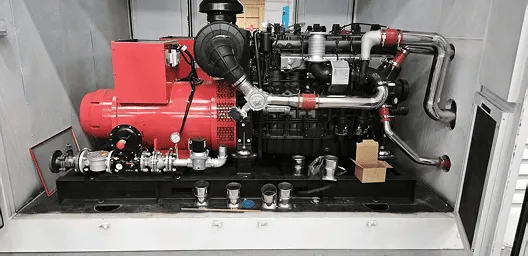
2 MW Gas Generators: 2 × 1,000 kW vs 8 × 250 kW
Choose 2 × 1,000 kW when a relatively steady load and fewer generating units suit the project. Evaluate 8 × 250 kW when smaller load increments, staged expansion and a smaller capacity loss during one-unit maintenance matter more. Both arrangements total 2,000 kW of nameplate capacity. Neither automatically supplies 2 MW with one unit unavailable, and eight units are not inherently cheaper or more fuel-efficient.
The decision needs a site load profile, the selected engines’ gas-consumption curves and a complete electrical design. Compare ratings on the same duty basis and site conditions; standby nameplate power is not automatically continuous plant output.
Two Large Units vs Eight Small Units
| Decision factor | 2 × 1,000 kW | 8 × 250 kW |
|---|---|---|
| Nameplate total | 2,000 kW | 2,000 kW |
| One unit unavailable | 1,000 kW remains before site derating | 1,750 kW remains before site derating |
| Dispatch increment | 1,000 kW per unit | 250 kW per unit |
| Equipment count | Two engine and generator packages | Eight packages and associated connections |
| Maintenance | Fewer service points; larger outage block | More service points; smaller outage block |
| Fuel economy | Depends on engine curves and dispatch | Depends on engine curves and dispatch |
| Layout | Check lifting, access and cooling clearance | Check total footprint, manifolds and clearances |
Nameplate Capacity Is Not Redundant Capacity
The simplest one-unit-out calculation is:
- Two-unit plant: (2 − 1) × 1,000 = 1,000 kW.
- Eight-unit plant: (8 − 1) × 250 = 1,750 kW.
These figures assume every remaining unit can deliver its stated rating at the site; they exclude derating, auxiliary loads and transient margins. At a required 2,000 kW plant load, both configurations lose sufficient capacity when one unit is unavailable.
If the critical load is 1,500 kW, seven 250 kW units provide more arithmetic headroom than a single 1,000 kW unit. That does not by itself prove uninterrupted operation. The system must keep appropriate units online or shed loads while another unit starts and synchronizes.
Caterpillar’s paralleling-control guidance explains N+1 capacity and control redundancy. Include common gas-supply, bus, switchgear and control failures in the review. More engines do not eliminate a shared failure point.
Load Staging: Where Smaller Units Can Help
Smaller units allow the controller to select more combinations of online capacity. This can keep active engines closer to an appropriate load band when plant demand varies. The benefit depends on minimum-load restrictions, starting limits, spinning reserve and the engine’s efficiency curve.
For an illustrative 600 kW steady load, one 1,000 kW unit operates at 60% of rating, while three 250 kW units operate at 80% each if equally loaded. This is a dispatch example, not evidence that the three-unit arrangement burns less gas. Request fuel data at those operating points and include auxiliary consumption.
A changing load adds another issue: large motors can demand a substantial step in power and reactive current. Offline nameplate capacity cannot respond instantly. Ask the designer to model the largest load step, frequency and voltage recovery, starting sequence and permitted load shedding.
Compare Gas Use and Complete Plant Cost
Evaluate each time band in the daily or seasonal load profile:
Annual gas cost = sum of each operating band’s hours × combined gas use of the online units × gas tariff.
Use the same gas heating value, standard volume reference conditions and duty rating for both quotations. Add the cost of starts, maintenance, overhaul reserves, gas treatment and plant auxiliaries. A lower price per engine does not establish a lower installed cost.
- Generating packages: engines, alternators, controls and warranted ratings.
- Gas system: pressure regulation, filtration, treatment, metering and distribution.
- Electrical system: breakers, synchronization, load sharing, protection and cabling.
- Site work: foundations, cooling, ventilation, exhaust, acoustic treatment and lifting access.
- Service: scheduled work on two or eight units, local parts and maintenance staffing.
There is no universal domestic-brand or imported-brand advantage attached to unit size. Compare exact models, support commitments and complete supply scopes.
When to Choose Each Arrangement
Favor Two Larger Units for a Stable Duty
Shortlist 2 × 1,000 kW when demand stays within a suitable range for one or two units, fewer service points matter, and the specified outage strategy is acceptable. Check what happens during maintenance rather than assuming the second unit can support the entire plant.
Favor Smaller Modules for Variable Demand
Shortlist 8 × 250 kW when recurring low and intermediate loads benefit from finer dispatch, or smaller maintenance blocks and staged additions have measurable value. Balance those benefits against more connections, inspections and protection devices.
Choose Neither Without Revisiting the Design
If the plant must deliver 2 MW with a unit unavailable, both proposals need additional capacity or a lower supported critical load. If fuel supply, the switchgear or the control system remains inadequate, changing the number of engines will not solve the problem.
Frequently Asked Questions
Are Eight 250 kW Units Always More Efficient?
No. They offer more dispatch combinations. Savings need to be demonstrated using the selected engines’ consumption data and your actual load profile.
Can Both Arrangements Supply the Same Peak Load?
They share a 2 MW nameplate sum. Net site output, duty rating, motor starting and reserve requirements can make usable capacity different.
Can Maintenance Be Performed Without Interrupting Production?
Only when the remaining capacity, switching arrangement and service-isolation procedure support the required load. Confirm the one-unit-out case and common equipment before accepting that promise.
What to Include in the RFQ
- Hourly load profile, minimum and maximum kW/kVA, and critical load.
- Largest motor or load step, voltage, frequency and power factor.
- Prime, continuous or standby duty and annual operating hours.
- Gas composition, heating value, available pressure and minimum supply flow.
- Altitude, temperature, space, noise and emissions requirements.
- One-unit-out capacity target, load-shedding policy and future expansion.
- Complete switchgear, installation, testing and service scope.
Read our diesel vs gas generator comparison if the fuel is still undecided. Send Zentramo your load profile and gas conditions to discuss a plant configuration and comparable quotation scope.