
Hay and Bale Handling
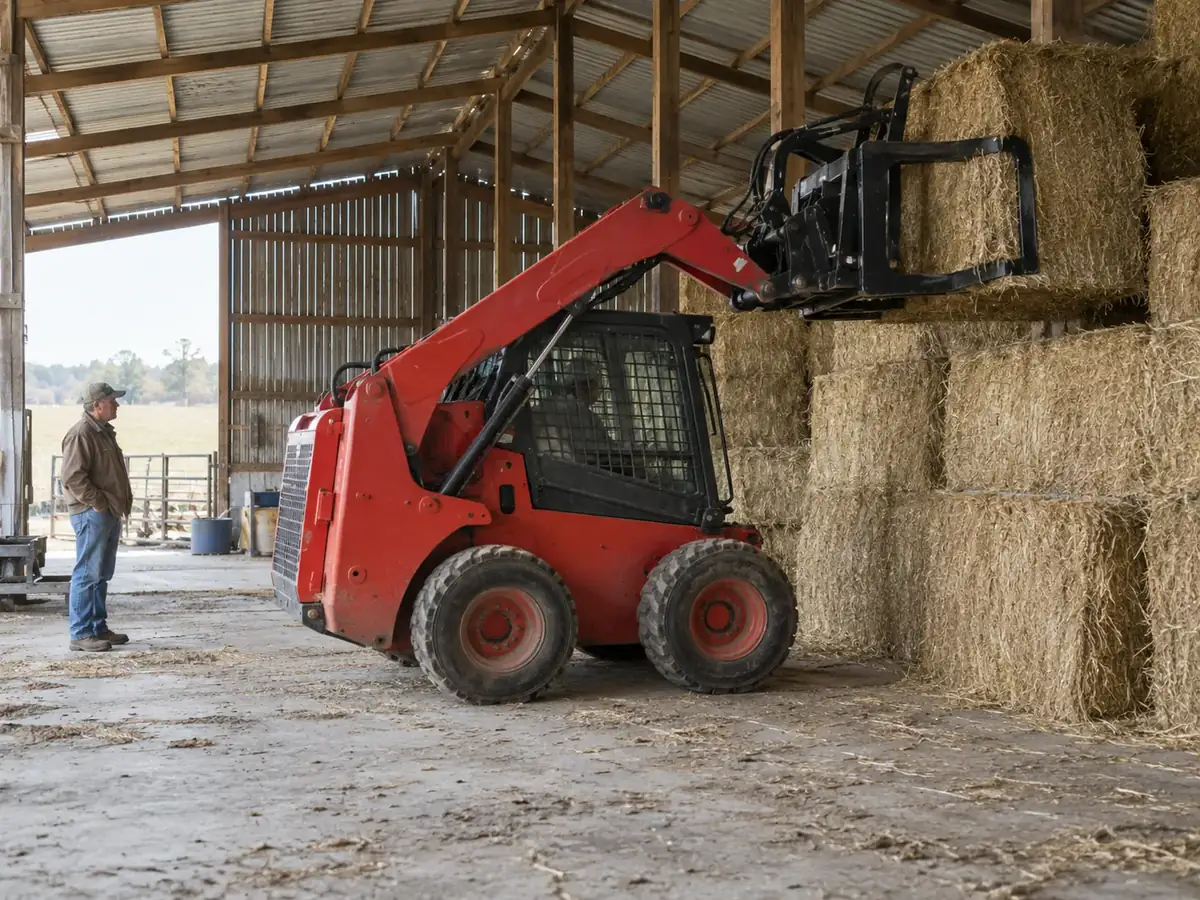
Round bales, rectangular bales and loose material need different tools. Confirm bale size and weight, spear or grapple geometry, attachment weight, load centre, lift path and stacking height.
BUILD THE FARM PACKAGE AROUND THE WORK YEAR
Move hay, feed, pallets, soil and fencing materials with one compact loader platform—when the load class, access width, ground conditions and attachment circuit are specified together.
Direct answer
A farm skid steer is a compact multi-purpose loader configured for feed, manure, bales, pallets, grading and seasonal attachment work around barns and fields.
For an accurate quotation, start with the application, access limits and required attachment—not an unverified model number.
| Decision layer | What belongs here |
|---|---|
| Known from the buyer | Barn access, surface and mud conditions, bale or material weight, lift height, daily tasks and attachment priorities. |
| Configured for the project | Wheel or track package, capacity, lift path, tires, auxiliary hydraulics, attachment interface and operator protection. |
| Verified before order | Dimensions, capacity and stability, hydraulic compatibility, service access, inspection record and delivery scope. |
THE FARM WORK YEAR
The right farm skid steer is not the machine with the longest attachment list. Begin with the task that repeats most often or creates the highest load, then verify the other seasonal tools inside the same machine, hydraulic and stability envelope.
Round bales, rectangular bales and loose material need different tools. Confirm bale size and weight, spear or grapple geometry, attachment weight, load centre, lift path and stacking height.
Buckets and pallet forks suit different materials. Record the real pallet or feed load, travel surface, doorway width, fork length and load centre before choosing the loader class.
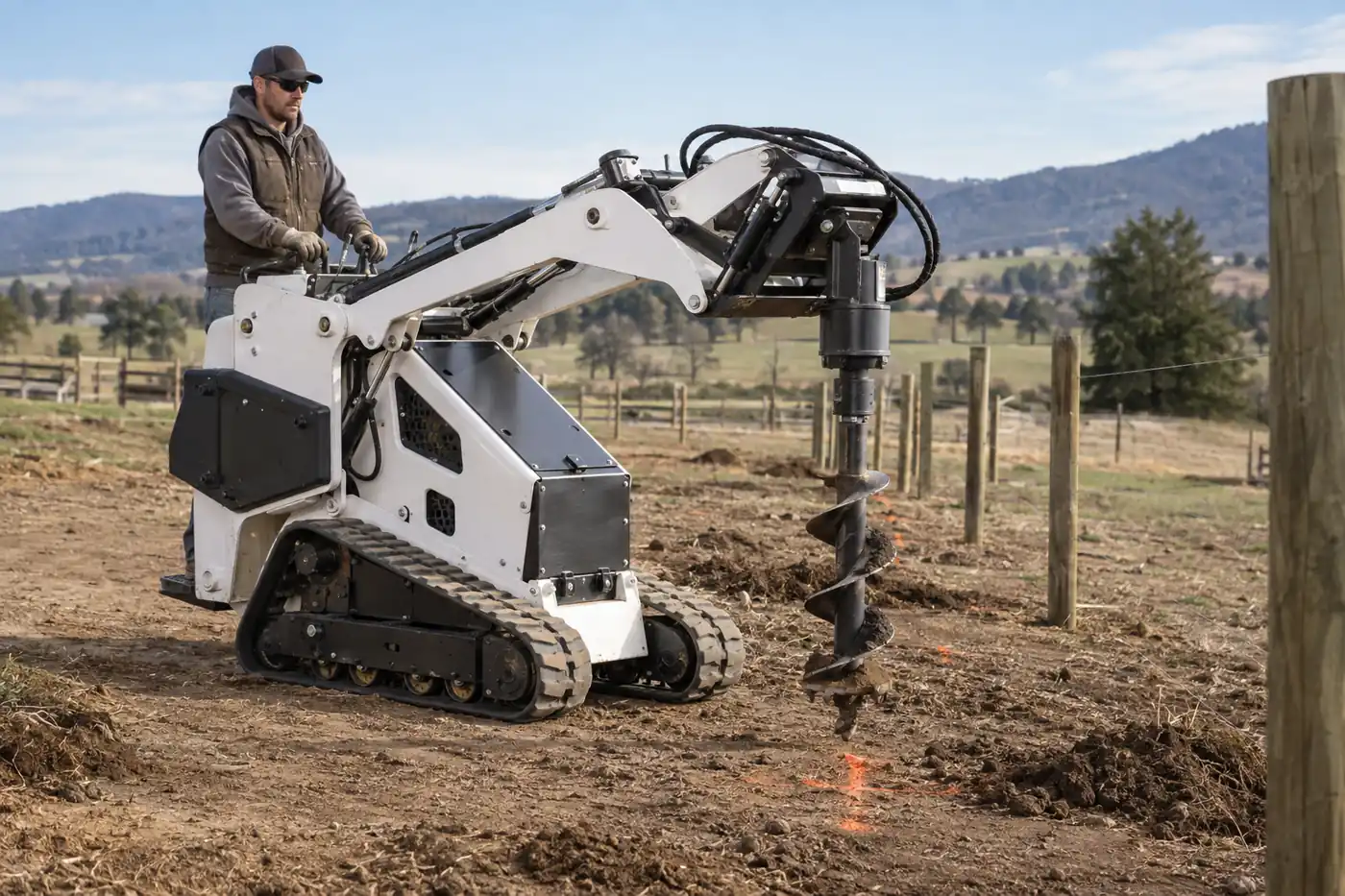
Augers and other powered tools add hydraulic demand. Soil type, bit diameter, target depth, flow, pressure, couplers and return requirements belong on the same specification sheet.
A bucket, grapple or sweeper may support manure handling, brush, loose material and yard cleanup. Match the tool to the material, route and safe operating zone instead of treating every attachment as universal.
CONFIGURATION RANGE
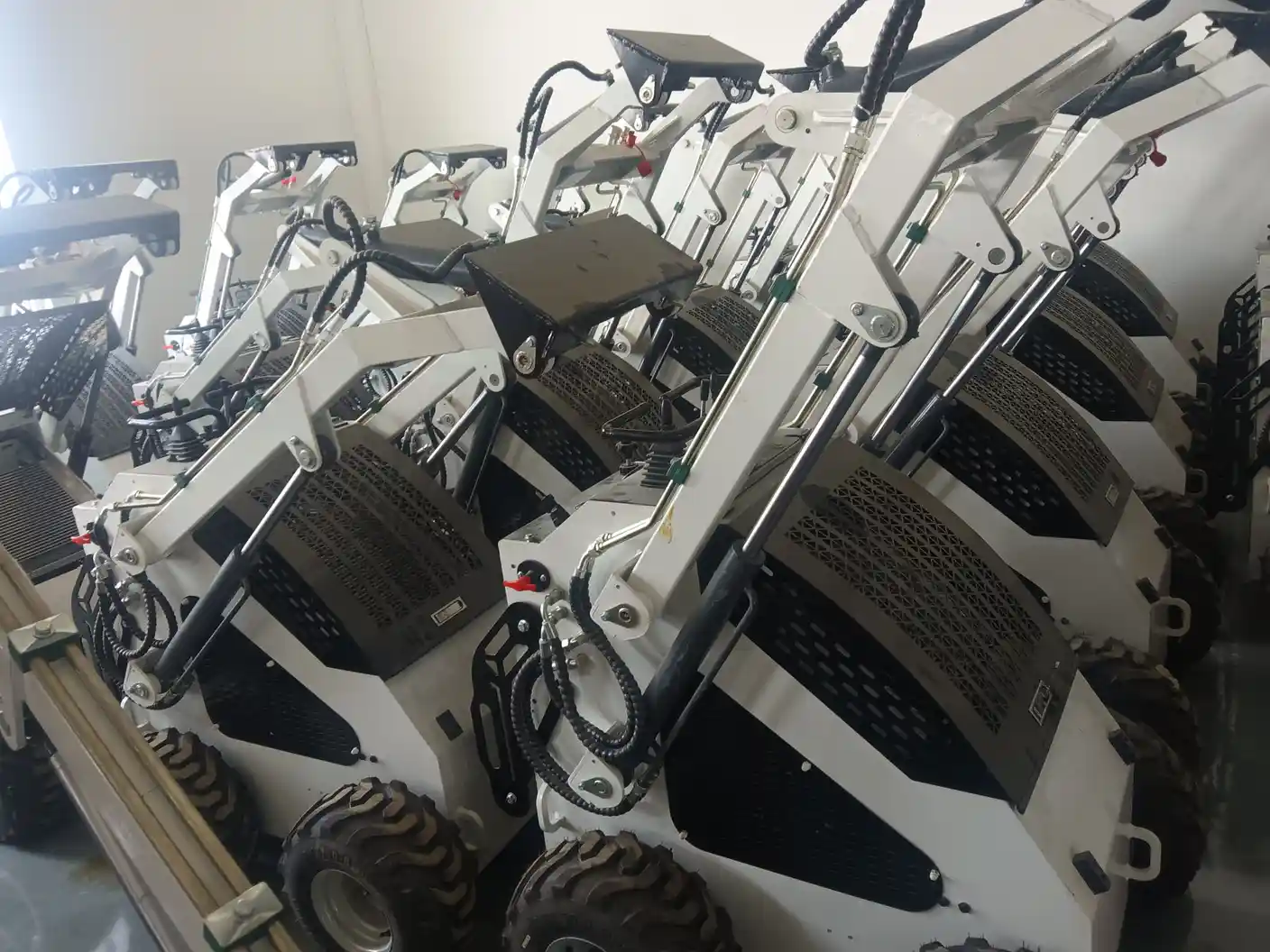
Hongrui’s verified range includes narrow and wider seated classes plus compact stand-on directions. The complete machine, bucket or farm attachment—not the bare chassis—must fit the gate, barn aisle, turning point and transport plan.
With an approximately 850 mm body and 900 mm standard bucket, this class is the starting point for restricted barn, greenhouse or farmyard access and light material handling after the full working envelope is checked.
Approx. 1,960 × 850 × 1,400 mm body · Approx. 920 kg machine weight · 20 MPa · Approx. 2,000 mm lift · Up to 10 km/h · Gasoline or diesel by model · Wheels or tracks by model
With an approximately 1,100 mm body and 1,100 mm standard bucket, this class is the stronger starting direction for heavier feed, pallet and farm-material work when the route, attachment weight and load centre remain within the confirmed configuration.
Approx. 1,960 × 1,100 × 1,400 mm body · Approx. 1,020 kg machine weight · 20 MPa · Approx. 2,000 mm lift · Up to 10 km/h · Diesel by model · Wheels or tracks by model
A rear operator platform can suit repeated ground-level tasks and compact routes. Wheel or track availability, control arrangement and hydraulic output depend on the selected model, so the machine and every planned attachment must be listed together.
| Model family | Undercarriage | Engine configuration | Body L × W × H | Standard bucket | Approx. weight | Class |
|---|---|---|---|---|---|---|
| S300 / SL300 | Wheeled / tracked | Runtong R740-1 gasoline, 739 cc | 1,960 × 850 × 1,400 mm | 900 × 420 × 600 mm | 920 kg | 300 kg |
| S350 / SL350 | Wheeled / tracked | Kepu KD292FA diesel, 0.997 L | 1,960 × 850 × 1,400 mm | 900 × 420 × 600 mm | 920 kg | 300 kg |
| S500 / SL500 | Wheeled / tracked | Laidong three-cylinder diesel | 1,960 × 1,100 × 1,400 mm | 1,100 × 420 × 600 mm | 1,020 kg | 500 kg |
| JS500 / JSL500 | Wheeled / tracked | Kubota 1105 diesel | 1,960 × 1,100 × 1,400 mm | 1,100 × 420 × 600 mm | 1,020 kg | 500 kg |
ATTACHMENT MATCH
A tool can lock onto the mounting plate and still be unsuitable for the carrier’s hydraulic circuit, remaining operating margin or work geometry. Quote the loader and attachments as one package.
| Farm attachment | Typical task | Mechanical / load check | Hydraulic or operating check |
|---|---|---|---|
| General bucket | Feed, loose material, soil and cleanup | Material density, bucket width and rated loading configuration | Loading height, travel route and safe handling zone |
| Pallet forks | Feed bags, pallets and farm supplies | Fork rating, attachment weight, pallet load and load centre | Floor or yard condition, doorway and lift path |
| Bale spear or grapple | Round or rectangular bale handling | Bale size and weight, tool geometry, attachment weight and load centre | Carry height, stacking height, visibility and stability |
| Auger | Fence posts, planting and ground work | Bit diameter, target depth, soil and mounting interface | Required flow, pressure, torque, couplers and return |
| Grapple | Brush, loose bulky material and cleanup | Opening size, attachment weight and balance | Auxiliary function, hoses and control method |
| Sweeper | Barn apron and yard cleanup | Working width and debris type | Hydraulic demand, dust-control plan and bystander zone |
A long attachment list is not a compatibility schedule. Put each selected tool and its hydraulic requirements on the written quotation.
SURFACE DECISION
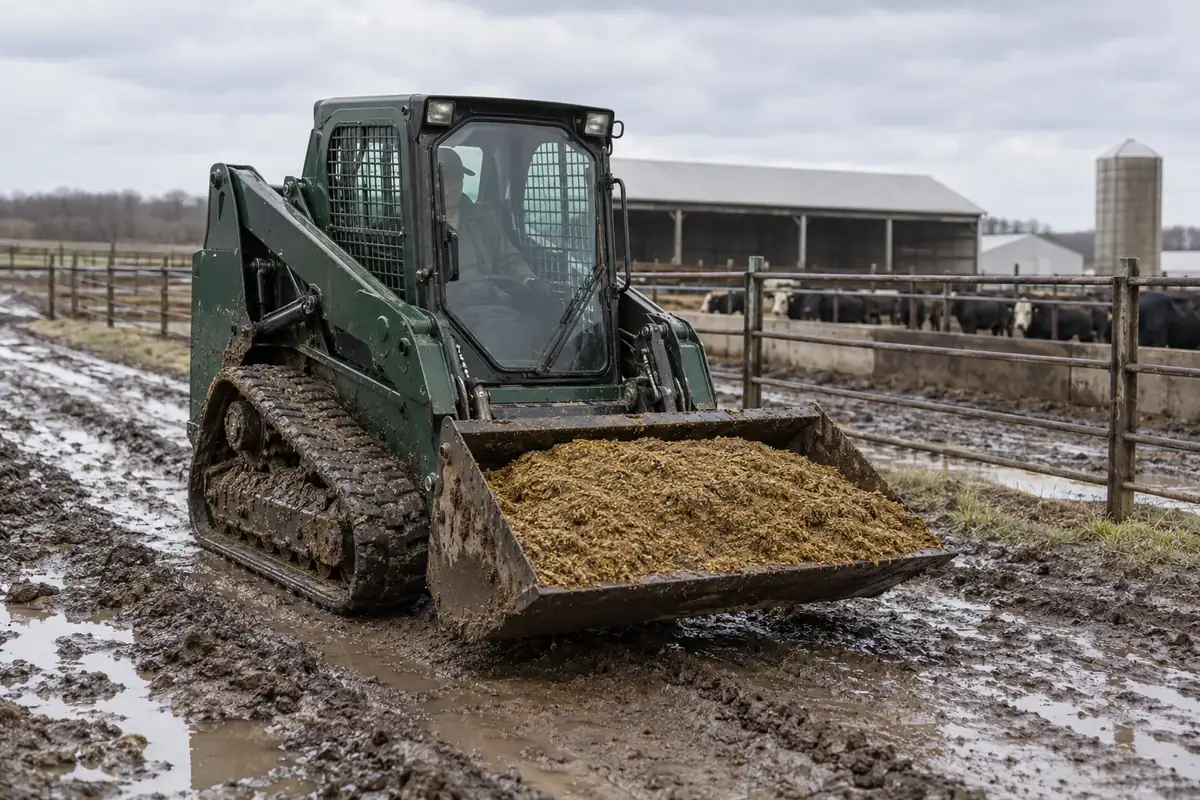
A firm barn apron and a muddy service lane may belong to the same farm. Compare the complete route, turning frequency, travel distance, slope, debris and maintenance routine rather than choosing from one clean photograph.
| Decision factor | Wheeled | Tracked | Farm implication |
|---|---|---|---|
| Firm yards and hard routes | Practical for frequent travel with simpler tire service | Can work, but hard-surface travel and pivoting remain part of wear planning | Count travel and turning between barns, storage and fields |
| Soft, loose or muddy ground | Tire choice and wheel slip become more limiting | More ground contact can improve traction and flotation | Evaluate the worst recurring lane, not only dry-season conditions |
| Sensitive surfaces | Higher point pressure and tire spin can mark ground | Wider contact spreads load, but pivot turns can still disturb turf | Operating practice and route planning matter for both |
| Maintenance | Tires and wheel condition are the main checks | Track tension, rollers and packed debris need attention | Include cleaning access, wear parts and inspection time |
| Transport | Confirm configured dimensions and weight | Include the selected track undercarriage | Trailer, loading and destination unloading must match the final machine |
MISMATCH CONTROL
The machine reaches the site but cannot enter the barn aisle or turn with the selected bucket, forks or bale tool.
Better checkMeasure the complete working envelope, including attachment width, hose routing, turning space and carry position.
Tool geometry, load centre or stacking height may not match the actual bale and storage plan.
Better checkRecord bale type, size, weight, carry path, stacking height and attachment weight before selecting the loader class.
Tool speed, heat, hose routing or control functions may prevent the planned task.
Better checkCompare required and available flow and pressure, coupler type, return path and control functions on one sheet.
A route that works in dry weather may create slip, rutting, cleaning burden or avoidable wear after rain.
Better checkChoose from the worst recurring ground and include maintenance capacity, not from the easiest month.
SMALL-FARM SELECTION
Farm size does not establish the correct skid steer size. A small operation handling dense bales or working on steep soft ground may need more machine margin than a larger property doing light yard cleanup.
Do not compare operating cost from purchase price or engine size alone. Compare the same task cycle, surface, attachment and maintenance assumption.
CONFIGURATION SUPPORT
Hongrui’s role is to turn the farm task list into a machine-and-attachment specification that can be reviewed before shipment. The final quotation should state the selected model, engine, undercarriage, attachment interface, hydraulic requirements and included scope.
BUYER GUIDE
Start with the work that repeats: a bucket for loose material, pallet forks for packaged loads, a bale spear or grapple for defined bale types, and an auger for fence or planting work. Grapples and sweepers add value only when their load, hydraulic and control requirements match the carrier. The essential package is the smallest set that covers the real work cycle without creating an incompatible hydraulic or load case.
Wheeled machines are a practical starting direction for firm yards, frequent travel and simpler undercarriage care. Tracked machines are worth evaluating when soft, loose, muddy or uneven ground controls access. Tracks add cleaning, tension and wear checks; wheels can lose traction or create more point pressure on soft ground. Compare the worst route and the complete ownership routine.
Choose from the heaviest repeated load, complete access envelope, surface and attachment demand—not acreage. The verified 300 kg seated class prioritizes an approximately 850 mm body, while the 500 kg class moves to an approximately 1,100 mm body and higher rated-load direction. Final suitability depends on the selected tool, load centre, lift geometry and stability basis.
Use the same duty cycle and attachment package. Compare fuel use under the planned work, tire or track wear, cleaning and inspection time, powered-attachment service items, hose and coupler maintenance, transport requirements and the cost of selecting a machine that cannot complete the hardest recurring task. Do not publish a universal hourly cost without local fuel, labor, service and utilization data.
List the exact model, engine, undercarriage, rated-load basis, dimensions, selected attachments, mounting interface, required and available hydraulic flow and pressure, couplers, return path, controls, included hoses, packing scope and destination requirements. A written machine-and-tool schedule is more useful than a photo-based attachment list.
BUILD THE FARM PACKAGE
Send the farm task list, heaviest load, narrowest access, worst ground, required working height and target attachments. Hongrui can use those inputs to prepare a machine-and-attachment configuration for quotation.
Final specifications and included scope are confirmed in the written quotation for the selected configuration.
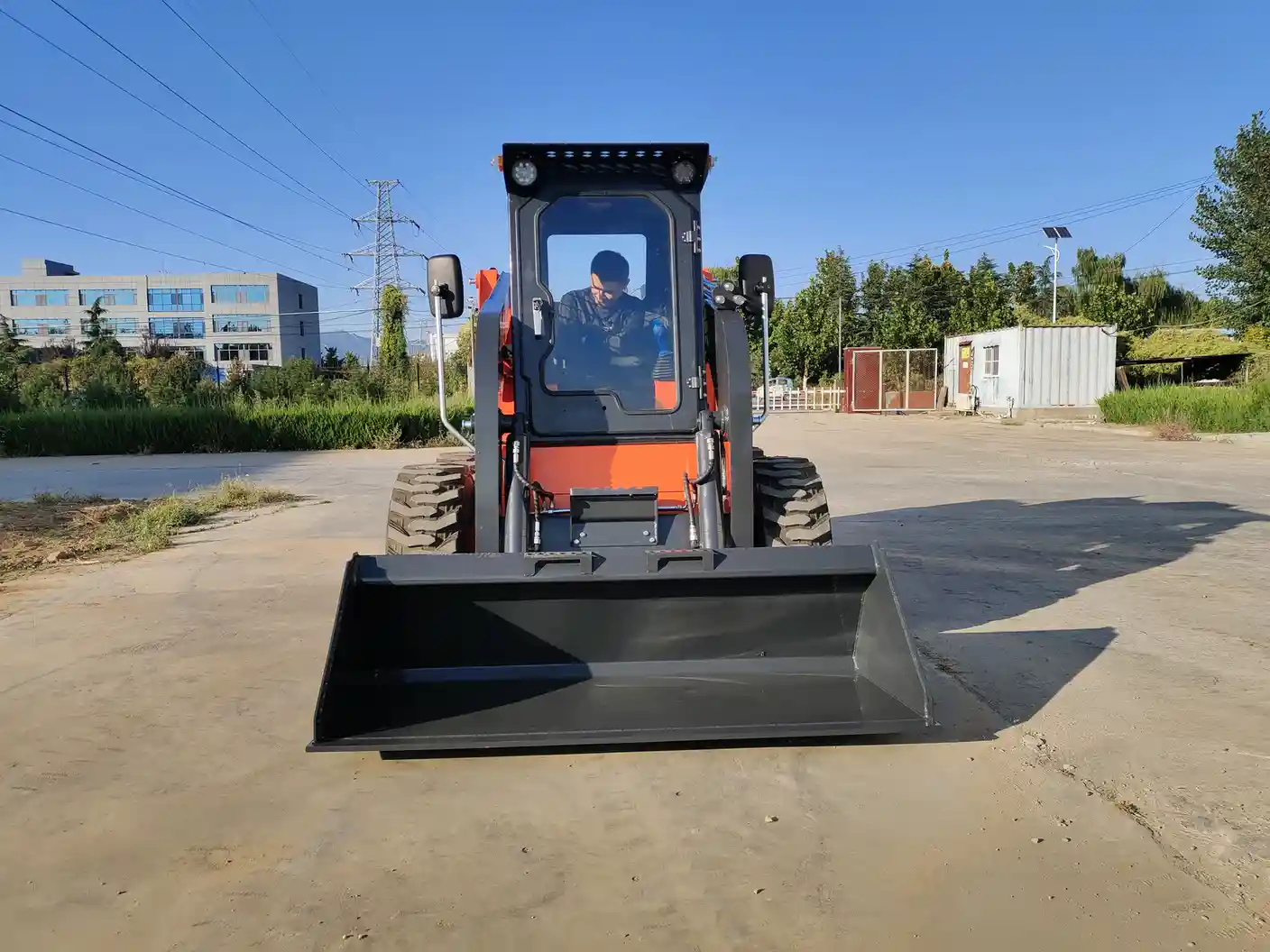
Evidence before commitment
A professional offer should connect the proposed configuration to evidence that can be checked before dispatch. Availability and document scope are confirmed for the specific order.
Configuration review, assembly checkpoints and key component traceability where applicable.
Function checks, leak inspection and order-specific test items recorded before shipment.
Required compliance documents are verified against destination and project requirements before order.
Packing method, loading photos and dispatch documents can be included in the delivery file.
Factory visits, remote video inspection or third-party pre-shipment checks can be coordinated when agreed. Published claims are not substituted for order-specific acceptance evidence.