Self-Loading Cement Mixer Lorries for Real Jobsite Conditions
Load materials, add water, mix, move and discharge concrete with one diesel-powered machine. Choose from documented configurations ranging from compact 1.8 m³ output models to a 6.5 m³ heavy-duty mixer lorry.
* Labor, efficiency and payback results vary with machine utilization, labor costs, concrete demand, material supply, operator performance and local jobsite conditions.
Labor Savings
An integrated loading, mixing, movement and discharge workflow can reduce dependence on multiple machines and manual handling.
Higher Jobsite Efficiency
Producing concrete closer to the pour can reduce waiting, repeated material transfer and coordination between separate processes.
Potential Payback
Suitable high-utilization projects may recover the investment through lower labor demand and a more integrated workflow.
Diesel-Powered Operation
The onboard diesel engine supports normal machine operation without dependence on an external electricity connection.
Figures are performance estimates for suitable applications, not guaranteed results. Actual savings and payback depend on local operating conditions.
One Machine for the Concrete Work Around the Pour
A self-loading cement mixer lorry combines material loading, water handling, mixing, short-distance movement and discharge in one mobile machine. Its onboard diesel engine allows the equipment to work without an external grid connection, making it practical for remote sites, temporary work areas and regions with unreliable electricity.
Conventional Transit Mixer
- Receives ready-mixed concrete from a batching plant
- Primarily transports concrete
- Depends on an established supply network
- Suitable for scheduled delivery routes
Self-Loading Cement Mixer Lorry
- Loads raw materials near the jobsite
- Handles water addition and mixing
- Moves concrete over short jobsite distances
- Operates through onboard diesel power
- Supports remote or irregular pours
Note: If your project only needs to transport ready-mixed concrete, a conventional transit mixer may be the more appropriate choice.
Choose the Mixer Lorry Class That Fits the Work
Start with actual output per batch. Then compare site access, terrain, discharge position, daily concrete demand and the equipment included in the quotation.
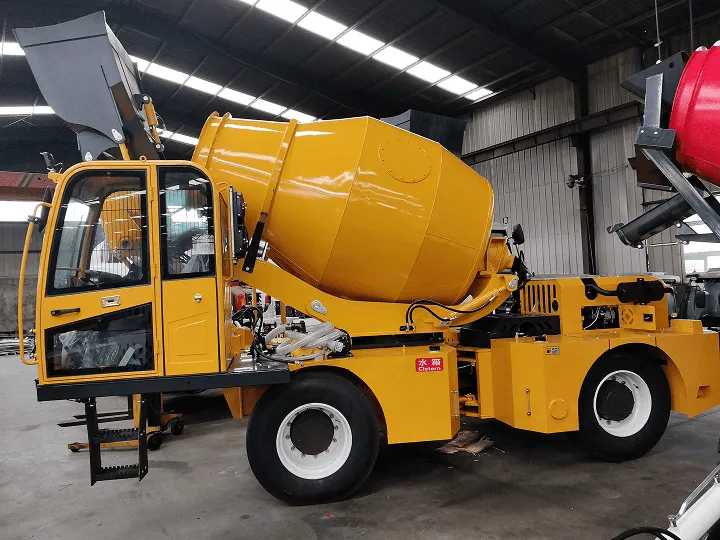
Compact Self-Loading Cement Mixer Lorries
Compact configurations are suited to restricted-access sites, small foundations, repair work and dispersed pours. Documented options include a 3,200 L drum with approximately 1.8 m³ actual output and a 4,500 L drum with approximately 2.4 m³ actual output.
- Yuchai 78 kW or model-dependent Yunnei engine option
- Articulated steering
- Drum lifting and up to 270° rotation on applicable models
- Available automatic water metering and external water pump
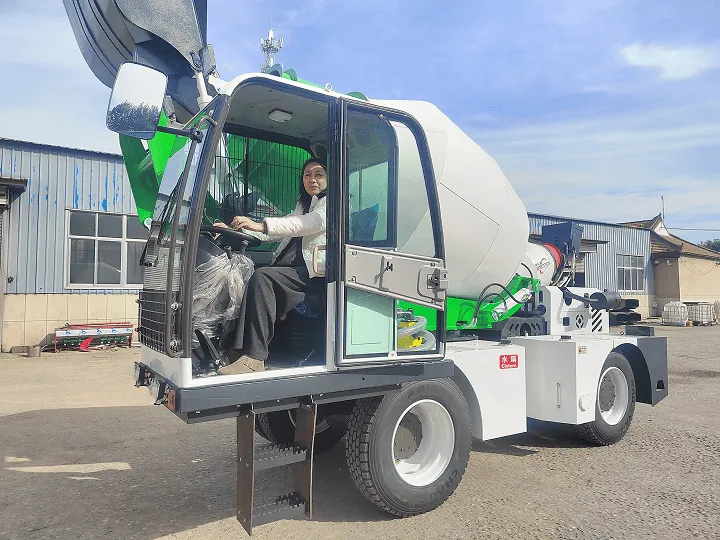
Medium-Capacity Self-Loading Mixers
This range balances batch output with jobsite mobility. Documented configurations include a 5,500 L drum with approximately 3.5 m³ actual output and a 6,500 L drum with approximately 4.0–4.5 m³ actual output.
- Yuchai 85 kW or 91 kW engine
- Articulated or integral-frame steering depending on model
- Model-dependent 10-ton or 12-ton axle
- Drum lifting and up to 270° rotation
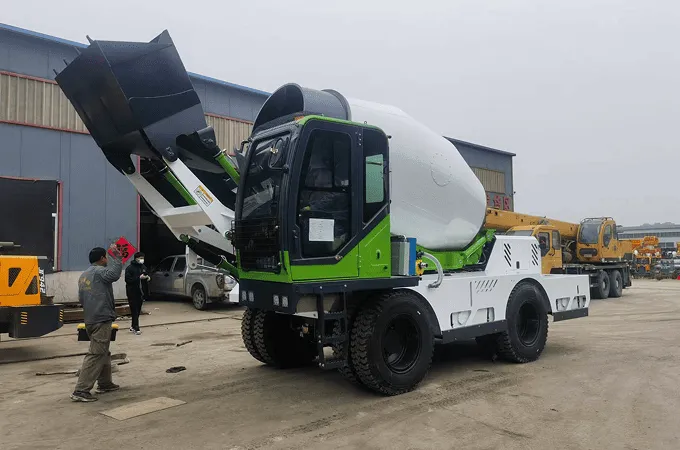
Heavy-Duty Self-Loading Mixer Lorry
The documented heavy-duty configuration combines a 9,800 L drum with approximately 6.5 m³ actual output for projects that require larger on-site batches and a heavier running system.
- Weichai 129 kW / 175 hp turbocharged engine
- 4WD; front and rear dual tyres (8 total)
- Drum lifting and up to 290° rotation
- Three-stage hydraulic cooling & emergency discharge
Reduce Labor and Coordination Between Separate Processes
By integrating loading, water handling, mixing, short-distance movement and discharge, a suitable self-loading mixer lorry can reduce the labor and coordination required by a conventional multi-machine workflow.
Multi-Step Concrete Workflow
- More equipment coordination
- More material handovers
- Additional labor between processes
- Greater exposure to waiting
Integrated Mobile Workflow
- One machine handles multiple work stages
- Concrete is produced closer to the pour
- Fewer transfers
- Less dependence on coordinated delivery schedules
These figures describe potential results under suitable utilization and operating conditions. Actual performance varies by project volume, labor rates, material handling method, machine utilization, operator experience and local site conditions.
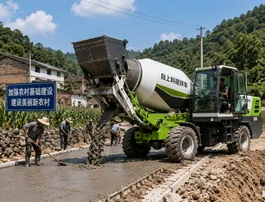
Keep Producing Concrete Where Grid Power Is Unavailable
The machine uses its onboard diesel engine for normal operating functions, so concrete production does not depend on an external electricity connection. This is especially useful for remote construction sites, undeveloped areas, temporary work zones and regions affected by an unstable power supply.
Onboard Diesel Power Loading Water Mixing Movement Discharge
Before ordering, confirm local diesel quality, engine requirements, emission rules, operating altitude, ambient temperature and maintenance conditions.
Built to Overcome Jobsite Challenges
Restricted Access
Compact dimensions and articulated steering options help navigate tight turning spaces and narrow site entrances.
Scattered or Irregular Pours
On-site production reduces waiting for external delivery schedules, making it practical for dispersed concrete work.
No Grid Power
The onboard diesel engine powers all material handling, mixing and movement without depending on an electricity network.
Difficult Discharge Positioning
Drum lifting, rotation up to 270°/290° and adjustable chutes help direct concrete accurately into forms or trenches.
Terrain and Working Load
Four-wheel drive options, heavy-duty axles and appropriate tyre configurations provide traction on uneven ground.
Water and Batch Control
Onboard water tanks, external pumps and automatic metering support consistent concrete mix ratios.
Compare Documented Output and Configuration
Drum volume and actual concrete output are not the same measurement. Compare suppliers using actual output per batch and the complete machine configuration.
| Actual output | Drum volume | Engine | Steering / Running system | Drum movement | Selection context |
|---|---|---|---|---|---|
| Approx. 1.8 m³ | 3,200 L | Yuchai 78 kW or Yunnei 55 kW | Articulated steering | Lift + up to 270° | Restricted sites and small pours |
| Approx. 2.4 m³ | 4,500 L | Yuchai 78 kW | Articulated steering | Lift + up to 270° | Small-to-medium work |
| Approx. 3.5 m³ | 5,500 L | Yuchai 85 kW | Articulated; documented 10-ton axle | Lift + up to 270° | General recurring production |
| Approx. 4.0–4.5 m³ | 6,500 L | Yuchai 91 kW | Integral frame/front-wheel steering; documented 12-ton axle | Lift + up to 270° | Higher-output requirements |
| Approx. 6.5 m³ | 9,800 L | Weichai 129 kW / 175 hp | 4WD; front and rear dual tyres | Lift + up to 290° | Heavy-duty projects |
Specifications vary by model and ordered configuration. Final engine, axle, hydraulic, water, weighing, tyre, transport and optional-equipment details must be confirmed in the quotation and sales contract.
Typical Jobsite Applications
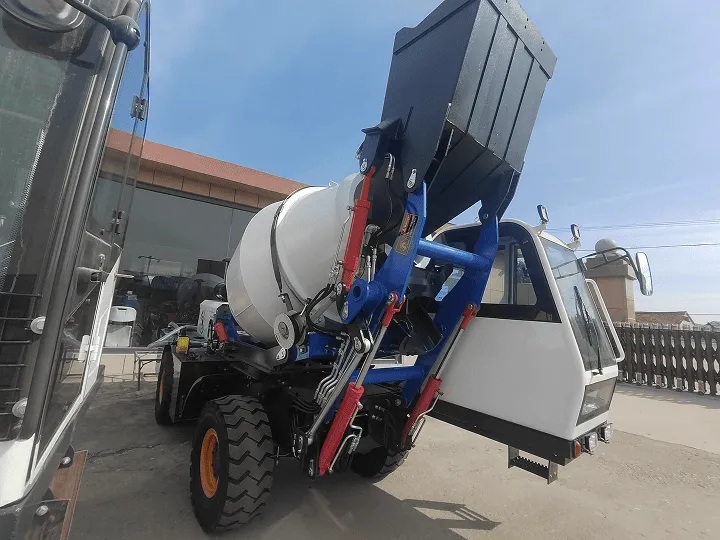
Remote Foundations and Small Structures
Produces concrete directly at the foundation site, avoiding the cost of long-distance transit mixer deliveries.
Checkpoint: Check access width and required daily volume.
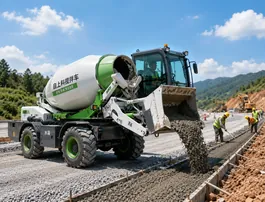
Rural Roads and Bridge Sections
Moves easily between scattered pour locations along a road alignment without returning to a central plant.
Checkpoint: Evaluate terrain gradient and axle load.
Municipal Repairs and Dispersed Pours
Compact models navigate urban streets and repair zones with minimal disruption to surrounding traffic.
Checkpoint: Confirm local emission rules and steering type.
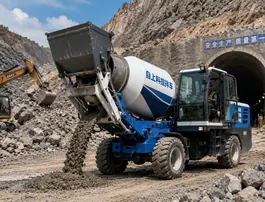
Infrastructure, Mining and Tunnel Support
Provides a continuous supply of concrete for tunnel linings, retaining walls and mining infrastructure.
Checkpoint: Verify clearance height and ventilation needs.
Off-Grid and Power-Unstable Projects
Maintains production schedules even when the local electricity grid is unavailable or unreliable.
Checkpoint: Confirm diesel supply and maintenance capability.
Discuss Your Specific Application
Send us your site details, and we will help evaluate if a self-loading mixer lorry fits your workflow.
Send Site Details on WhatsAppEngineered for On-Site Concrete Production
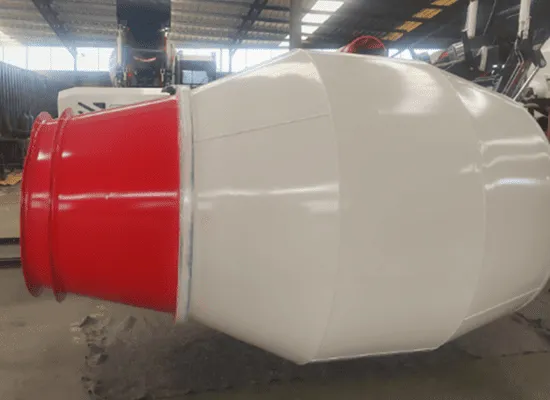
Actual Output Shown Separately
We clearly distinguish between geometric drum volume and actual concrete output per batch to prevent undersized orders.
Integrated Concrete Workflow
Combines loading, mixing, and transport into one machine, reducing the need for separate loaders and transit mixers.
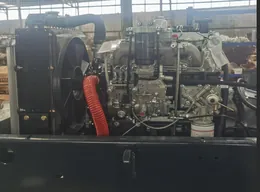
Diesel-Powered Independence
Equipped with dependable diesel engines (e.g., Yuchai, Weichai) to power hydraulic and driving systems without grid electricity.
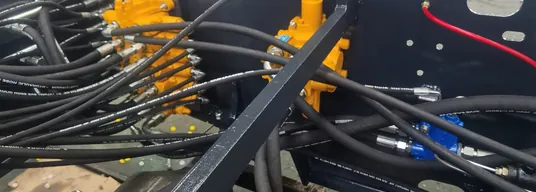
Multiple Running-System Paths
Options include articulated steering for tight spaces, integral frames for stability, and heavy-duty axles for rough terrain.
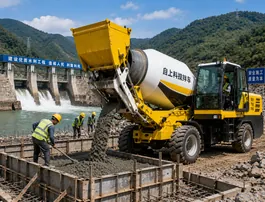
Flexible Discharge Positioning
Drum lifting and rotation (up to 270° or 290° depending on model) allow concrete to be poured precisely where needed.
Water and Batch-Handling Options
Available configurations include automatic water metering, external pumps and weighing systems for better mix control.
For suitable projects, the integrated workflow may save up to 60% on labor, improve jobsite efficiency by up to 40% and support payback in as little as six months. Actual results depend on utilization, labor rates, concrete demand, site layout and operating conditions.
How to Choose the Right Cement Mixer Lorry
Define the Concrete Workflow
Determine if you need to load raw materials on-site or just transport ready-mixed concrete.
Calculate Required Output
Match the machine's actual output per batch to your daily concrete demand and pour sizes.
Measure Site Access
Check road widths, height restrictions and turning spaces to ensure the machine can maneuver.
Assess Terrain and Utilities
Consider gradients, ground conditions, water sources and the availability of grid power.
Check the Discharge Layout
Verify if you need drum lifting, rotation, or extended chutes to reach the pour location.
Compare the Complete Quotation
Review the engine, axles, hydraulics, included options and shipping terms before ordering.
Information to Prepare
- Country and project type
- Concrete required per day
- Volume per pour
- Access width and height
- Ground and gradient
- Grid-power availability
- Local fuel and emission requirements
- Required discharge direction
- Water source and weighing requirement
Could a Self-Loading Mixer Reduce Your Project Costs?
Current Costs
- ✗ Loading/material-transfer labor
- ✗ Separate equipment and operators
- ✗ Delivery waiting
- ✗ Dispersed-pour delays
- ✗ Downtime from unavailable grid power
- ✗ Daily volume and working days limitations
Potential Improvement
- ✓ Fewer manual stages
- ✓ Less equipment coordination
- ✓ Production closer to pour
- ✓ Diesel-powered operation without grid dependence
- ✓ Higher utilization
These are potential performance outcomes rather than guaranteed financial results. A project-specific comparison should use local labor rates, fuel cost, concrete demand, working days, machine utilization and the current production method.
Buying Checks That Prevent Costly Specification Gaps
Do Not Treat Drum Volume as Actual Output
A 4,500 L drum produces approximately 2.4 m³ of concrete per batch. Always base your calculations on actual output, not geometric volume.
Check What the Quotation Includes
Ensure the quotation explicitly lists the engine brand, axle capacity, water system, weighing equipment and any requested options.
Do Not Oversize the Machine
A 6.5 m³ lorry is highly productive but requires wider access and solid ground. A compact 2.4 m³ model may be more efficient for restricted sites.
Confirm Fuel and Destination Requirements
Verify that the engine meets local emission regulations and that the machine can operate safely in your region's climate and altitude.
Treat Options as Model-Dependent
Features like 290° rotation, four-wheel drive, or specific weighing systems are not standard on every model. Ask for clarification.
Use the Confirmed Quotation and Contract
Website images are for reference. The final technical specifications must be agreed upon in the official sales contract.
Frequently Asked Questions
Does a self-loading cement mixer lorry need an external electricity supply?
How can a mixer lorry reduce labor requirements?
Can it improve jobsite efficiency?
Can the machine pay for itself in six months?
What makes a mixer lorry suitable for heavy-duty work?
Which class suits small-batch construction?
How should quotations be compared?
When is a conventional transit mixer better?
How should it be operated safely?
A Clear Configuration Before You Order
A professional purchase starts with a configuration that both sides can verify. Before an order is confirmed, the machine should be reviewed against the project, worksite and destination requirements.
Verification Checklist
- Actual output and drum volume
- Engine model and rated power
- Fuel and emission requirements
- Transmission, axle and drive
- Tyres and steering
- Drum lifting and rotation
- Water pump, tank and metering
- Weighing and loading
- Hydraulic cooling & emergency discharge
- Packing, shipping & destination
Final supply details are defined by the confirmed quotation and sales contract. General page information and product photographs do not replace the agreed configuration list.
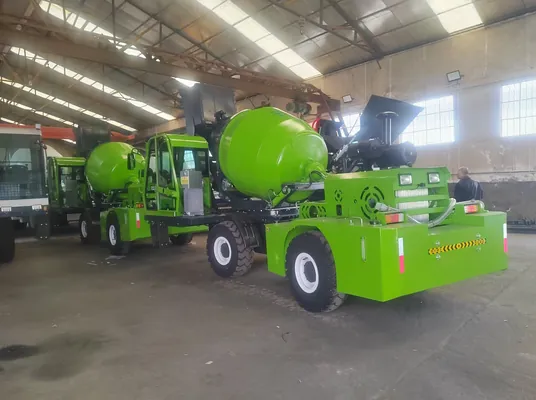
Equipment Configured for Your Site
Tell us where the machine will work, how much concrete you need and which operating conditions it must handle. We will use that information to discuss a suitable configuration.
Request a Cement Mixer Lorry Configuration
Fill out the form below or contact us on WhatsApp for faster response.