
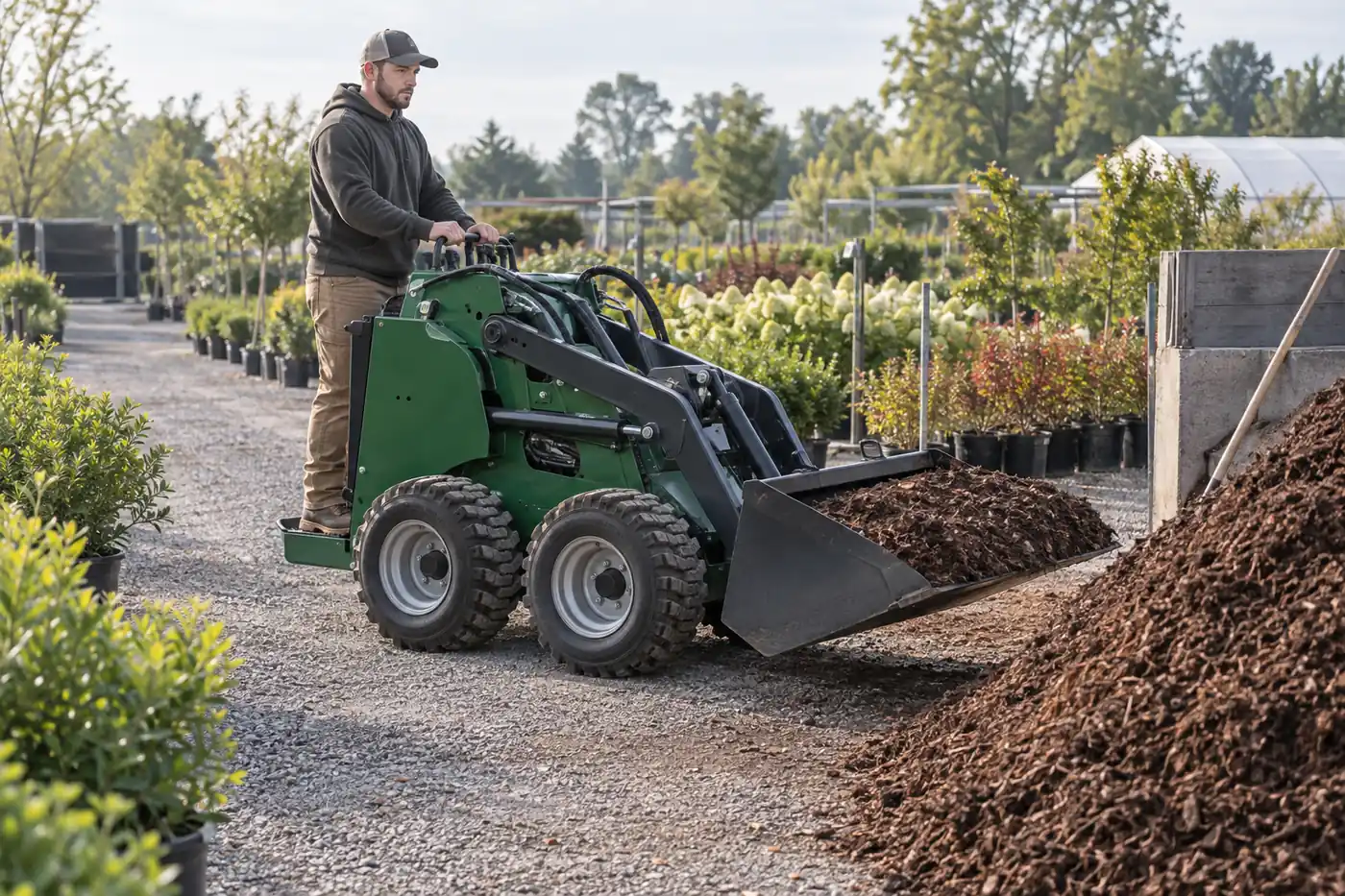
Mini Skid Steer for Landscaping: Build the Machine Around the Work
Move soil and mulch, prepare beds, drill planting holes, handle branches and clean restricted sites with one compact stand-on carrier—when access, ground conditions, hydraulics and the attachment sequence are specified together.
Direct answer
What Is a Mini Skid Steer for Landscaping?
A landscaping mini skid steer is a compact attachment carrier selected to move soil, mulch, plants and pallets through narrow residential or commercial access routes.
For an accurate quotation, start with the application, access limits and required attachment—not an unverified model number.
| Decision layer | What belongs here |
|---|---|
| Known from the buyer | Gate width, turf sensitivity, slopes, travel surface, material weights and required landscaping tasks. |
| Configured for the project | Track or wheel package, ground pressure, hydraulic flow, bucket, auger, trencher, forks and control layout. |
| Verified before order | Access dimensions, rated capacity, attachment compatibility, surface protection plan, inspection record and shipment scope. |
Start with the Landscape Work Sequence
A mini skid steer creates value when it follows the crew through several connected tasks. Choose the carrier from the hardest repeated task, then confirm that every remaining tool fits the mount, hydraulics, access route and ground conditions.
Enter the Property
Measure the narrowest gate, path, turn and overhead clearance with the selected attachment installed—not only the bare carrier.
Move Bulk Material
Match bucket size and load to soil, mulch, gravel or compost density, the travel route and the required dump position.
Prepare and Plant
Grade compact areas, open planting holes or trenches and keep tool width, hydraulic demand and underground hazards inside the plan.
Handle Green Waste
Grapples and forks can move branches, logs, pallets and bagged materials when attachment weight, load centre and remaining capacity are checked.
Finish and Leave Clean
Plan the final grade, sweep or debris removal before the machine enters the site so the last tool does not become a second delivery.
Decision line: If the crew repeats several tasks, specify the machine and attachment sequence as one package instead of buying a bucket-only loader and solving compatibility later.
Choose a Stand-On Configuration for the Ground and Access
Hongrui’s stand-on range includes wheeled and tracked directions across S-200 and S-250 model families. Final engine, controls, hydraulic output, attachment interface and rated operating details are confirmed for the selected configuration in the written quotation.
| Model | Verified configuration direction | Known control or engine detail | Landscaping selection focus |
|---|---|---|---|
| S-200S | Tracked stand-on mini loader | Runtong twin-cylinder, 739 cc | Track layout, access route, attachment demand and required hydraulic output |
| S-200SC | Wheeled or tracked stand-on configuration | Mechanical controls | Firm routes versus soft ground, mount type and auxiliary circuit |
| S-200SP | Wheeled or tracked stand-on configuration | Mechanical controls | Work cycle, control arrangement and powered attachment functions |
| S-250P | Tracked stand-on configuration | Mechanical controls; dual-output arrangement | Auxiliary functions, couplers and multi-function attachment requirements |
Model availability and final component combinations may vary by quotation. Put the selected machine, undercarriage and every planned attachment on the same written configuration schedule.
Wheels or Tracks? Protect the Route, Not Just the Work Area
A machine may work well in the planting bed and still damage the route that reaches it. Compare the driveway, lawn, turning points, slopes, loose fill and cleanup burden together.
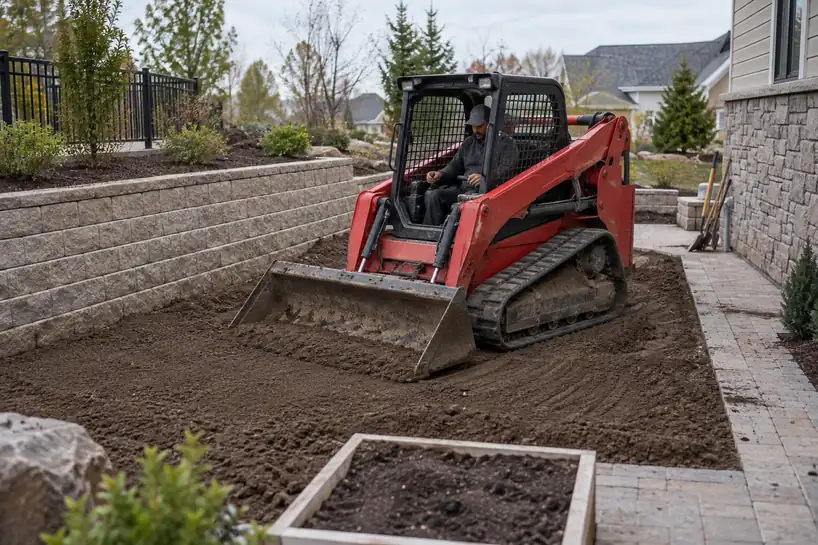
Direct-answer callout: Choose wheels when firm travel routes and simpler undercarriage care drive the work. Evaluate tracks when loose or uneven ground makes traction and flotation the stronger priority. Turning technique and ground moisture influence surface damage in both cases.
Read the detailed tracked versus wheeled guide →| Landscape condition | Wheeled direction | Tracked direction | Buyer check |
|---|---|---|---|
| Firm driveway or prepared path | A practical starting point for frequent travel and simpler undercarriage care | Can travel on firm routes, but turning and track wear remain part of the cost | Record travel distance, surface finish and the number of tight turns |
| Established lawn | Tire choice, ground moisture and steering technique affect marking | The larger contact area can spread the load, but pivot turns can still disturb turf | Plan the travel line and restoration standard; do not assume either undercarriage is automatically turf-safe |
| Loose soil, mud or uneven ground | Traction depends on tire selection and ground condition | Worth evaluating when traction and flotation matter more than simple undercarriage service | Use the worst route the machine must cross, not the cleanest project photo |
| Slopes and cross-slope travel | Follow the selected machine manual and avoid exceeding its operating limits | Track contact does not remove rollover, slip or load-position risk | Confirm slope, surface, attachment, load position and approved operating procedure |
| Debris and cleanup | Inspect tires and remove damaging debris | Clean the undercarriage and inspect tracks, rollers and tension | Include daily cleaning time and wear items in the comparison |
Match Landscaping Attachments to the Job Phase
The attachment package should follow the work sequence and the carrier’s actual mechanical and hydraulic limits. A tool that mounts to the plate is not automatically compatible with the machine circuit or remaining load margin.
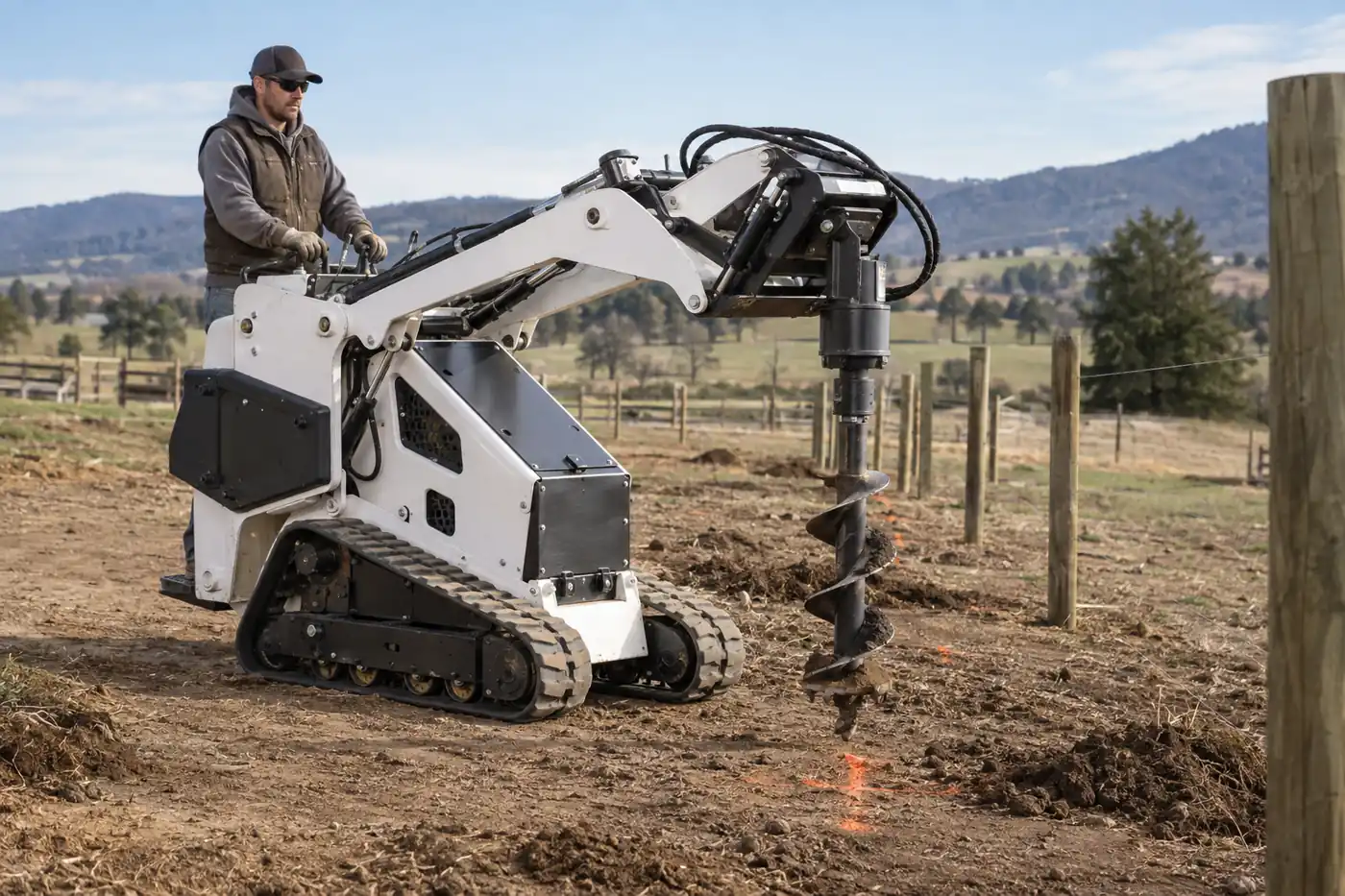
Beds, Planting and Fence Lines
Bucket
Move soil, mulch, compost or aggregate. Confirm material density, bucket width, travel route and the selected machine’s rated loading configuration.
Auger
Drill planting or fence-post holes. Confirm ground condition, bit diameter, required torque, hydraulic flow, pressure and underground hazards.
Trencher
Open narrow routes for irrigation, drainage or utilities. Confirm trench width and depth, chain type, soil condition, hydraulic demand and required return path.
Brush, Materials and Final Cleanup
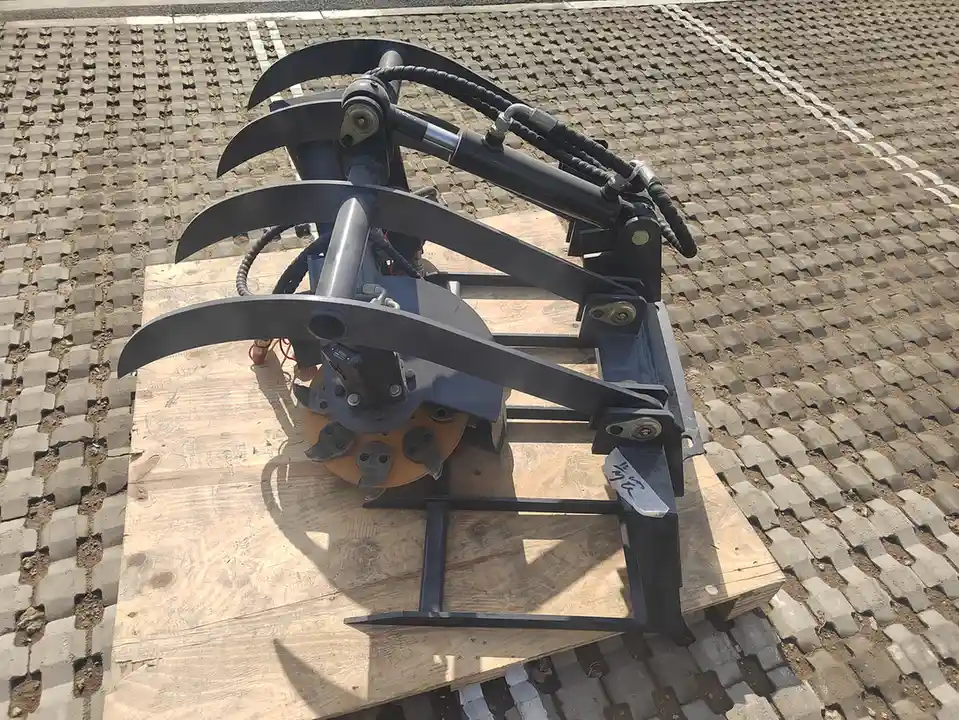
Grapple or Grapple Rake
Handle branches, roots and irregular debris. Confirm opening, attachment weight, load balance, couplers and required hydraulic functions.
Pallet Forks
Move sod, pavers, plants or bagged materials on pallets. Confirm fork rating, load centre, attachment weight and remaining capacity with the fitted tool.
Sweeper
Clean driveways, paths and site exits. Confirm working width, surface condition, flow demand, debris handling and transport position.
Six Checks Before a Powered Attachment Reaches the Site
Compatibility is a system check. Review the carrier and each powered tool together before the quotation is approved.
Mechanical Mount
Confirm the plate or pin interface, locking method and attachment geometry.
Hydraulic Flow
Match the attachment’s required flow range to the selected model configuration.
Operating Pressure
Confirm both machine and attachment requirements rather than assuming a familiar tool will work.
Couplers and Return Path
State coupler type and size, hose routing and any case-drain or dedicated-return requirement.
Weight and Load Centre
Include attachment weight and projected load position when judging remaining operating margin.
Controls and Functions
Multi-function tools may require an auxiliary or dual-output arrangement and the matching operator control.
Buyer mistake callout: Buying attachments from photos or plate dimensions alone can leave the crew with a tool that mounts but cannot be operated correctly.
Compare the Complete Landscaping Package, Not the Machine-Only Price
There is no useful universal purchase price for a professional landscaping setup. The comparable number is the total written scope for the machine, undercarriage, hydraulics, attachments, export preparation and support items.
Base Model and Operating Configuration
Model family, engine or control direction, lift geometry and the selected rated operating basis.
Wheels or Tracks
Undercarriage components, transport weight, traction priorities, cleaning and expected wear items.
Hydraulic Package
Auxiliary functions, flow and pressure requirements, couplers, hoses and return paths.
Attachment Set
Tool type, working width, weight, cylinders or motors, replaceable wear parts and quantity.
Transport and Export Scope
Complete dimensions and weight, packing, loading method and destination documentation.
Service Preparation
Manuals for the selected configuration, parts identification and a practical spare wear-item list.
Put the Same Scope on Every Quotation
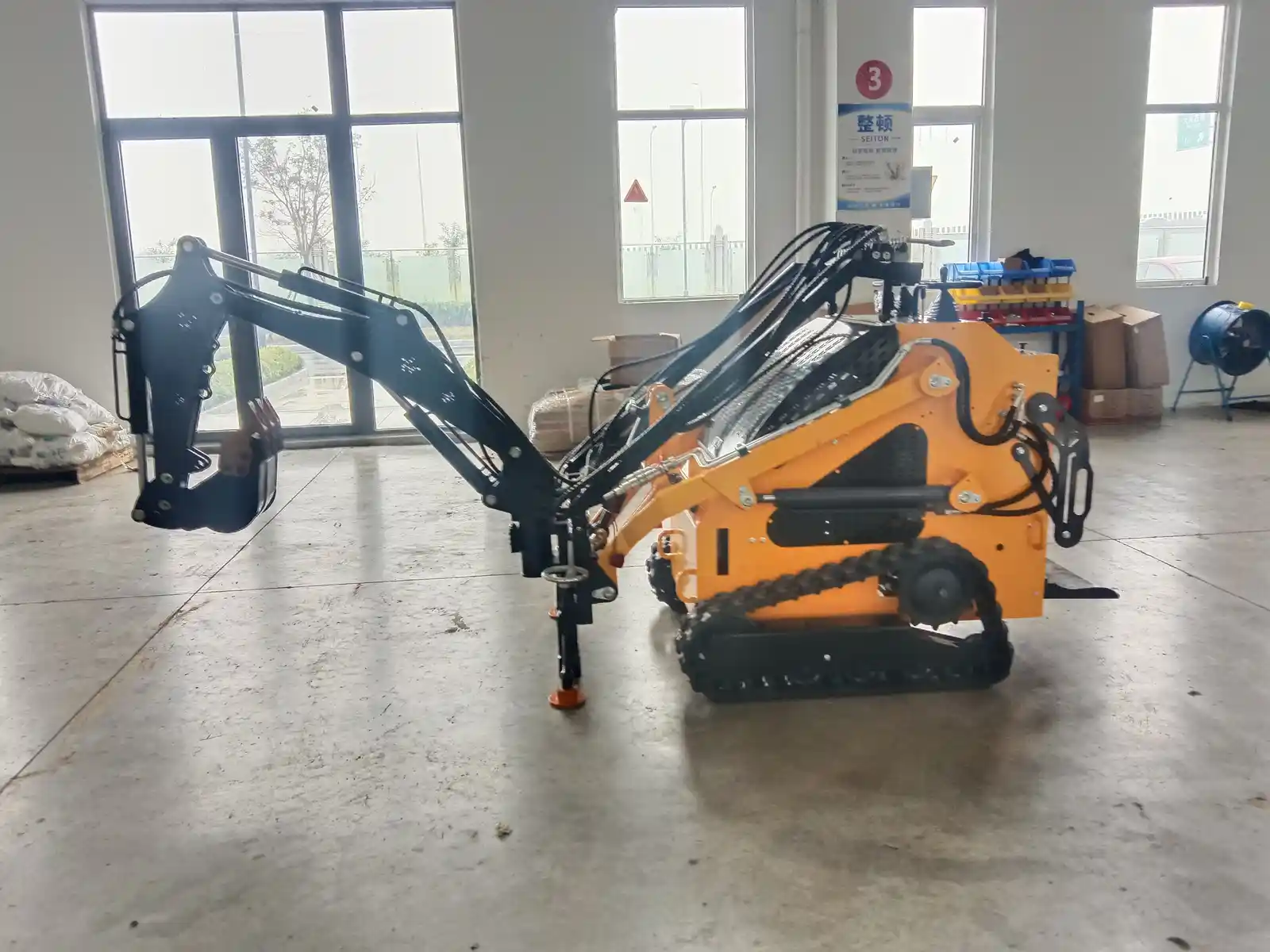
Turn the Landscape Plan into a Written Machine Configuration
Hongrui is based in Jining, Shandong, China. The team supports OEM/ODM and configuration communication for machinery projects, followed by technical consultation, after-sales coordination and spare-parts support for the agreed scope.
What the Written Scope Should Identify
- Selected model and wheeled or tracked configuration
- Engine or control direction stated in the quotation
- Attachment names, sizes, mount and required hydraulic functions
- Couplers, hose routing and return-line requirements
- Complete machine-and-tool dimensions and weight for transport planning
- Manuals, parts identification and agreed support items
Pre-Delivery Review Focus
Use the agreed configuration as the reference for assembly and function review. Drive, steering, lift, attachment locking, controls and auxiliary functions should be checked against the selected machine and tool package before shipment arrangements are finalized.
Mini Skid Steer Questions for Landscaping Projects
What attachments are essential for residential landscaping?
Should a landscaping mini skid steer use wheels or tracks?
How do I choose a mini skid steer for landscaping work?
Can a compact utility loader work in a small backyard?
What makes a mini skid steer suitable for professional landscape crews?
How should I compare mini skid steer quotations?
What daily checks matter in landscaping conditions?
Continue with the Right Loader Comparison
Need the full stand-on product range?
Review model directions, attachment matching, cost factors and operating guidance for Hongrui mini skid loaders.
Explore Mini Skid LoadersComparing confined-site capacity classes?
Review 300 kg and 500 kg seated classes when body width, access and material handling are the main decision.
Compare Compact Skid LoadersNeed the broader loader family?
Compare seated and stand-on, wheeled and tracked configurations across the complete skid steer range.
View Skid Steer LoadersPlan One Loader Around the Landscaping Work You Repeat
Share the repeated tasks, narrowest access point, ground conditions, attachment sequence, maximum material load and destination. Hongrui can use those details to discuss a wheeled or tracked model direction and prepare a written machine-and-tool configuration for review.
Useful inputs include site photos, access dimensions, surface and slope, material and load, required tools, working height, destination and order quantity.
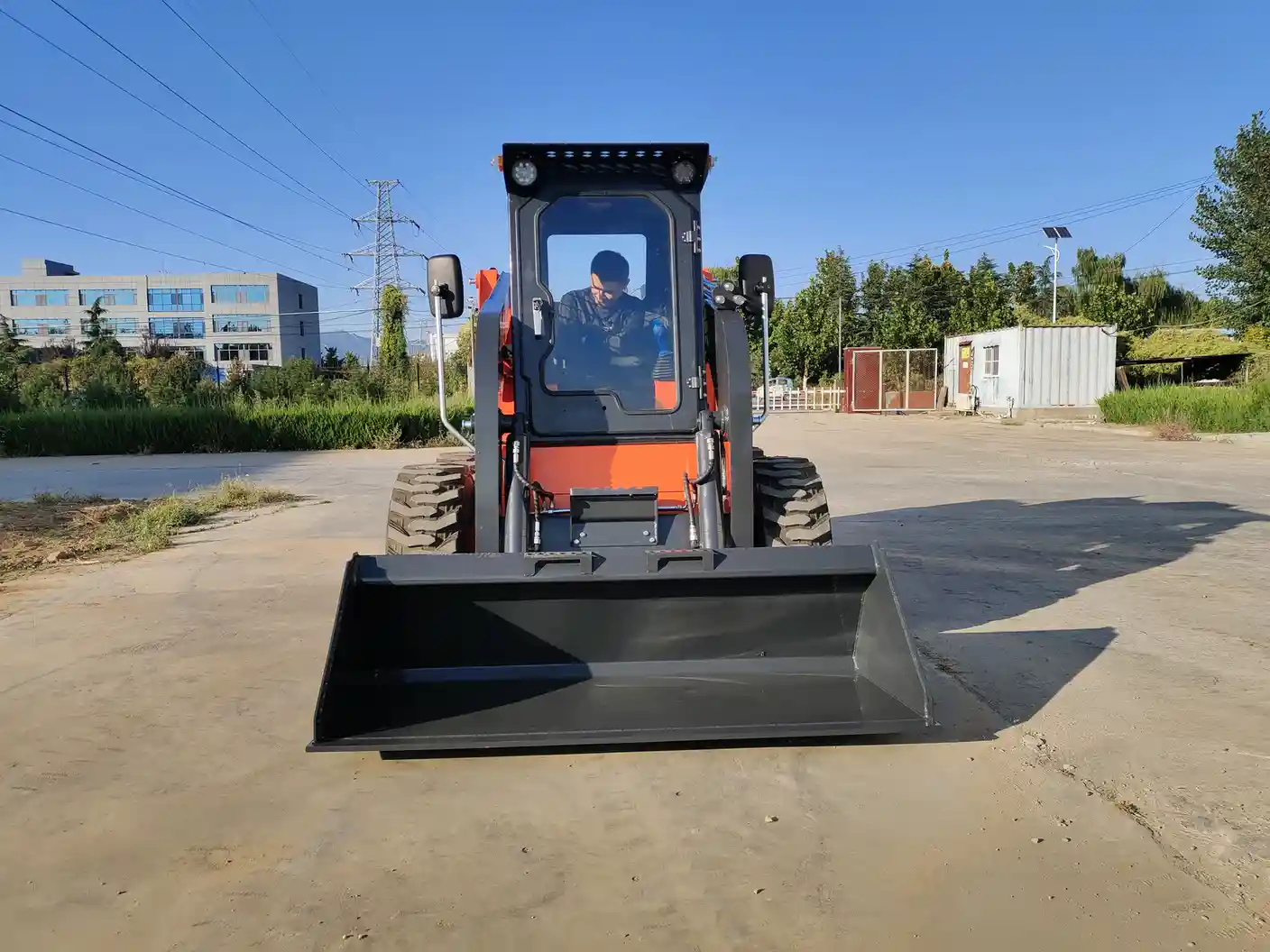
Evidence before commitment
Production, Inspection and Delivery Evidence
A professional offer should connect the proposed configuration to evidence that can be checked before dispatch. Availability and document scope are confirmed for the specific order.
Production record
Configuration review, assembly checkpoints and key component traceability where applicable.
Inspection & testing
Function checks, leak inspection and order-specific test items recorded before shipment.
Certificates & documents
Required compliance documents are verified against destination and project requirements before order.
Packing & shipping
Packing method, loading photos and dispatch documents can be included in the delivery file.
Buyer visit or pre-shipment acceptance
Factory visits, remote video inspection or third-party pre-shipment checks can be coordinated when agreed. Published claims are not substituted for order-specific acceptance evidence.