
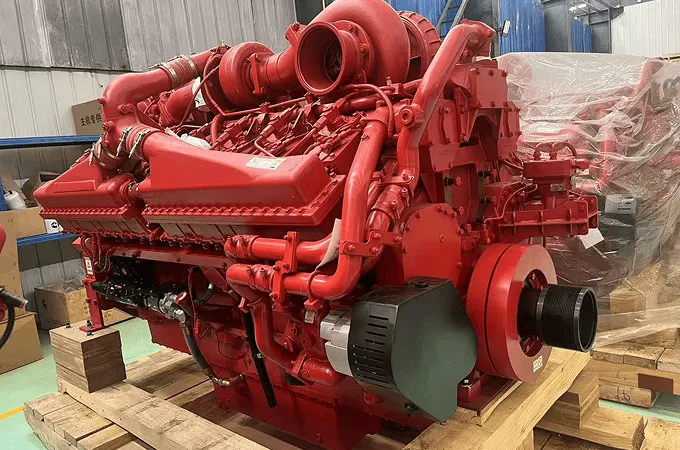
How much oil does a Belaz 75710 hold?
Total engine oil is roughly 440–520 liters (two MTU 16V4000 V16s at about 220–260 liters each). The truck’s hydraulics add approximately 1,000–1,500 liters, with more in hubs/gearboxes. Exact capacities depend on the specific engine rating and hydraulic package.
Engine architecture and systems
- Powertrain: Two MTU 16V4000 diesel engines drive generators for electric wheel motors; each engine’s sump defines lubricating oil volume.
- Hydraulics: Steering, braking, and body hoist circuits draw from a large hydraulic reservoir.
- Other fluids: Final drives, wheel hubs, and cooling systems add significant volumes beyond engine oil.
Typical capacities by subsystem
- Engine oil per 16V4000: 220–260 L (model/rating dependent)
- Total engine oil (two engines): 440–520 L
- Hydraulic reservoir: 1,000–1,500 L
- Final drives/hubs/gearboxes: 100–300 L combined
- Coolant per engine: 200–300 L
Verification steps
- Confirm engine oil capacity from MTU/Detroit Diesel 16V4000 datasheet for the exact rating installed.
- Check BelAZ build sheet for hydraulic tank option size and auxiliary circuits.
- Measure actual fill at maintenance to account for filters, lines, and inclines.
What Ford truck has the 7.3 Godzilla engine?
Ford’s 7.3L “Godzilla” gasoline V8 is factory-offered in Super Duty F-250, F-350, and F-450 (since 2020), medium-duty F-650/F-750, E-350/E-450 cutaway vans, and the F-53/F-59 commercial chassis. It’s also available as a crate engine for swaps.
Model availability overview
- Light/Heavy pickups: F-250, F-350, F-450 Super Duty
- Medium-duty: F-650, F-750
- Commercial cutaway: E-350, E-450
- Motorhome/strip chassis: F-53 (motorhome), F-59 (commercial)
- Aftermarket: Crate engine for performance and fleet conversions
Why fleets pick 7.3 Godzilla
- Simpler maintenance vs. diesel for certain duty cycles
- Strong low-end torque for towing
- Lower acquisition cost and emissions equipment complexity than HD diesels
- Broad parts support across Ford’s commercial lineup
Is there a V12 pickup truck?
No automaker has released a factory-production V12 pickup truck. V12 pickups exist only as custom builds or exhibition trucks using swapped car/marine/industrial V12 engines. Production high-cylinder pickups have peaked at V10 (e.g., Ram SRT-10, Ford Triton V10).
Context and examples
- Production: No OEM V12 pickups; V10s were the highest cylinder-count in mainstream models.
- Customs: Hobbyist or demonstrations may swap BMW/Mercedes/Toyota V12s or marine V12s into pickups; not street-legal or warrantied.
- Alternatives: Modern turbocharged V8 diesels and big gasoline V8s cover torque needs with better packaging and reliability.
Does International use Cummins engines?
Yes. International (Navistar) offers Cummins engines across many models alongside its A26 engine. Common Cummins options include B6.7, L9, X12, and X15, depending on chassis and duty class.
Model-to-engine availability
- MV Series (Class 6–7): Cummins B6.7, Cummins L9
- HV Series (vocational): International A26; Cummins L9 options
- HX Series (heavy vocational): International A26; Cummins X15 options
- LT Series (on-highway): International A26; Cummins X15 options
- RH Series (regional): International A26; Cummins X15 options
Why mixed engine sourcing
- Application fit: Match displacement/torque to duty cycle (regional haul, vocational, long-haul)
- Service network: Cummins’ broad support aids uptime
- Emissions and reliability: Post-MaxxForce era pushed wider Cummins availability while A26 serves efficiency niches
Is Mack truck owned by China?
No. Mack Trucks is owned by Volvo Group (Sweden) and has been since 2000. Volvo Group is separate from Volvo Cars (owned by Geely). Mack’s headquarters remain in North America, with manufacturing and R&D integrated within Volvo Group’s global commercial vehicle operations.
Ownership clarity
- Parent: Volvo Group AB (Gothenburg, Sweden), publicly traded
- Brand separation: Volvo Group (trucks, buses, construction) vs. Volvo Cars (Geely ownership)
- North American footprint: Mack operations in Pennsylvania and other US locations
Why was Bigfoot 8 banned?
Bigfoot 8 was effectively banned by USHRA in the early 1990s due to its radical lightweight tube-frame chassis and advanced long-travel suspension, which created an outsized performance advantage and raised safety concerns under then-current rules. The team shifted to other series after rule changes.
Key factors behind the ban
- Chassis: Purpose-built tubular frame reduced weight dramatically
- Suspension: Long-travel, coil-over/cantilever design improved speed and control
- Competitive balance: Considered an unfair advantage versus leaf-spring trucks
- Safety and regulation: Event organizers updated rules disallowing Bigfoot 8’s configuration
Impact on the sport
- Sanctioning split: Bigfoot focused on alternative series (e.g., PENDA)
- Technology cascade: Eventually the sport standardized on safer, engineered tube frames under new regulations
What’s the most powerful truck engine?
On-highway: Volvo FH16’s D17 (780 hp, about 3,800 Nm) is currently the most powerful production road truck engine. Off-highway haul trucks use far larger engines; Cummins QSK60 and MTU 16V4000 variants reach 2,300–2,700 hp per engine.
Power leaders by application
- On-highway (EU): Volvo D17 (FH16 780) ≈ 780 hp, ~3,800 Nm
- On-highway (EU): Scania DC16 770 ≈ 770 hp, 3,700 Nm
- On-highway (US): Cummins X15 ≈ up to 605 hp, 2,050 lb-ft
- Off-highway (mining): Cummins QSK60 up to ~2,700 hp; MTU 16V4000 ~2,300 hp per engine
How “most powerful” varies
- Road-legal limits: Emissions, fuel economy, and drivetrain longevity cap power
- Off-road: Power is dictated by payload, gradeability, and generator/e-drive systems on ultra-class trucks (e.g., BelAZ, Caterpillar, Komatsu)
BelAZ Engine Shipping, Packaging & Customs Clearance Guide
Ship BelAZ 75710 engines as hazardous heavy machinery with robust crating, correct HS classification, and destination-specific compliance. Use engineered skids, corrosion control, and certified lifting plans; prepare emissions and safety paperwork; choose Incoterms and insurance aligned to risk tolerance.
Shipment anatomy and planning
- Contents: Two diesel-generator engines (e.g., MTU 16V4000), alternators, control cabinets, cooling modules, spares, tooling
- Mode: Ocean (flat rack/open-top or breakbulk), occasionally rail; air is impractical due to weight
- Schedule: Coordinate with mine shutdowns and onsite cranes
Typical packaging specs
- Skid/crate: Steel-reinforced base, ISPM-15 compliant wood, shock indicators
- Corrosion: VCI wraps, desiccants, humidity indicator cards, oil-film preservation where permitted
- Restraint: Cross-bracing, engine cradle, blocked on COG; lift via OEM lugs only
Dimensional and weight planning
- Engine (single 16V4000): 6,500–7,500 kg dry; add 500–1,000 kg crating
- Crate footprint (each): ~3.0–3.5 m L × 1.8–2.2 m W × 2.0–2.4 m H
- Ancillary modules: Radiators, alternators, cabinets often ship separately to optimize handling
Document checklist by destination
- Core docs: Commercial invoice, packing list, sales contract, certificate of origin
- Emissions (US): EPA Form 3520-21 for nonroad CI engines; EPA certificate of conformity (40 CFR Part 1039)
- Emissions (EU): Declaration of conformity for Stage V (where applicable)
- Dangerous goods: If fuel/oil retained, declare UN3528 “Engines, internal combustion, flammable liquid powered” (Class 9); SDS
- Insurance: Cargo policy with “All Risks,” include project-specific clauses (Institute Cargo Clauses (A))
Customs classification and regulatory matrix
| Item | HS Code (suggested) | Notes |
|---|---|---|
| Compression-ignition diesel engine | 8408.90 | Verify subheading with broker based on displacement/use |
| Generator/alternator (industrial) | 8501.53 / 8501.61 | Depends on kVA rating |
| Radiator/cooling modules | 8419.89 | Heat-exchange equipment |
| Control cabinets/electrical panels | 8537.10 | Boards/panels for control/distribution |
| Spare filters/gaskets | 8421.23 / 4016.93 | By part type |
Incoterms selection
- FCA/FOB: Buyer controls main carriage; good for experienced shippers
- CIP/CIF: Seller covers carriage and minimum insurance; clarify war/strike clauses
- DAP/DDP: Door delivery; DDP adds tax and compliance burden to seller
- Recommendation: Use FCA or CIP with explicit risk transfer and packaging responsibilities
Handling and lifting plan
- Tools: Spreader bars sized to lift points; certified slings/shackles
- Procedure: Lift to vertical, no side-loading on lugs; keep engines dry and sealed
- Records: Photos, lift certificates, weigh tickets, shock/tilt monitor logs
Risk controls
- Moisture: Maintain <50% RH in crate; change desiccants per transit duration
- Shock: Use impact indicators; reject handling if G exceeds OEM limit
- Theft/substitution: Seal logs, GPS trackers on high-value crates
Port and carrier selection
- Vessel: Prefer direct call ports, low transshipment risk
- Stowage: Under-deck for weather; avoid lash-up near corrosive cargo
- Carrier terms: Heavy-lift surcharges, breakbulk booking windows, stow plan approval
Insurance and liability
- Valuation: Include engine, spares, packaging, freight
- Clauses: Institute Cargo Clauses (A), Delay in Start-Up (if tied to project timeline)
- Claims: Pre-shipment survey and outturn survey to document condition
Onsite receipt and commissioning
- Inspection: Check humidity cards, impact indicators, seals; document anomalies
- Preservation removal: VCI and preservative oil removed per OEM procedure
- Pre-lube: Spin oil pumps, prime fuel, verify ECU configs before start-up
- Compliance: Keep emissions and import docs on file for audits
Common pitfalls and how to avoid them
- Misclassification: Engage a licensed customs broker early; pre-classify each line item
- Oil/fuel residue: Drain to permitted limits to avoid DG classification when possible
- Noncompliant wood: Use ISPM-15 stamped materials; retain treatment certificates
- Missing EPA paperwork (US): Secure certificates and forms before sailing
Timeline template (weeks)
- 0–1: Final specs, HS pre-classification, crate design approval
- 2–3: Fabrication, preservation, packing; book vessel
- 4–6: Ocean transit; broker submissions; customs pre-clearance
- 6–7: Port outturn, inland haulage, site delivery, commissioning prep
Contact points
- OEM: Engine builder for preservation and lifting instructions
- Freight forwarder: Heavy-lift specialist with project cargo experience
- Customs broker: Destination-specific emissions and HS compliance advisor
- Insurer/surveyor: Pre- and post-shipment condition documentation